
Sunday, July 28, 2013
Gold Is Solely A Play On Capital Appreciation
Nouriel Roubini : "Unlike other assets, gold does not provide any income. Whereas equities have dividends, bonds have coupons, and homes provide rents, gold is solely a play on capital appreciation. Now that the global economy is recovering, other assets – equities or even revived real estate – thus provide higher returns." - in A World Of Ideas


Saturday, July 27, 2013
The Ongoing Weakness of America’s Economy
France Is Slipping Into A Recession
Fed's Liquidity Injections Are Not Creating Credit For The Real Economy
Be Sure Your Seat Belt Is Securely Fastened
Huge Gap Between Sentiment On Wall Street And The Main Street
Market Outlook: Gravitational Forces & Levitational Forces
But you have the gravitational forces of slow economy leading eventually to correction, but then the levitational forces of QEs, zero policy rates, more money coming in the market – not just from the U.S., but from other economies – it's going to levitate asset prices.
 So, as I pointed out,
this might lead to a generalized credit and equity and asset bubble in
the next year or two, followed by a crash. But for the next year or so,
as long as the economy grows 1.5-2 percent, and you have easy money,
this market can go higher. "- in Business Insider
So, as I pointed out,
this might lead to a generalized credit and equity and asset bubble in
the next year or two, followed by a crash. But for the next year or so,
as long as the economy grows 1.5-2 percent, and you have easy money,
this market can go higher. "- in Business Insider
Friday, July 26, 2013
Roubini : The Commodity super-cycle may be over
....., The commodity super-cycle that helped Brazil, Russia, South Africa, and many other commodity-exporting emerging markets may be over. Indeed, a boom would be difficult to sustain, given China's slowdown, higher investment in energy-saving technologies, less emphasis on capital- and resource-oriented growth models around the world, and the delayed increase in supply that high prices induced. - excerpt from a Nouriel Roubini article in the Guardian
Thursday, July 25, 2013
Nouriel Roubini vs. James Rickards
Nouriel Roubini also known as Dr. Doom Nouriel Roubini,decided to ask James Rickards, author of "Currency Wars," why he advocates for a return to the gold standard in his book "currency wars," when it was this return to gold that was a direct cause of the Great Depression. James Rickards responded by pointing out that it was not the return to gold, but rather the return to gold at the pre-WWI price that necessitated deflation, which exacerbated the depression. Nouriel then went to town on Rickards with, what became, full out, personal insults. He called James Rickards "arrogant" and said that the Wizard of OZ is a better read for those who want to understand the gold debate than Currency Wars
Wednesday, July 24, 2013
Nouriel Roubini Interview @ The EPI Summit 2013
EPI Summit 2013 - Speaker Interview - Nouriel Roubini, Roubini Global Economics
The 13th European Pensions & Investments Summit delivered more than
25 hours of world class briefings from some of the leading minds in the
pensions industry including: ATP, APG, British Steel Pension Scheme,
City of Oslo Pension Fund, Pension Protection Fund, UK Minister for Work
and Pensions and many more.
Join the 2014 Summit along with
leading regional pension investors and global asset managers in an
intimate environment for a focused discussion of key new drivers shaping
institutional investment strategies today.
Tuesday, July 23, 2013
The Oil Boom’s Foreign Policy dividend
By John Hannah and Nouriel Roubini
July 19, 2013
The domestic benefits of the U.S. oil production boom are well documented — everything from the creation of high-paying jobs to sending less money to foreign oil producers.
Less well appreciated are the geopolitical benefits. U.S. oil production has already paid foreign policy dividends in at least one vital area: It has paved the way for stronger sanctions on Iran by helping to keep the global oil market well-supplied and minimizing oil price volatility.
This development is timely and instructive.

By the first half of 2014, according to credible estimates, Iran is likely to be able to covertly produce enough highly enriched uranium for one nuclear device in as little as seven to 10 days — before it could be detected by the international community. While it remains unclear how close Iran is to nuclear weapons capability, the consensus is that the window for preventing it from happening is closing.
read more : http://blogs.reuters.com/great-debate/2013/07/19/the-oil-booms-foreign-policy-dividend/ >>>>>>
July 19, 2013
The domestic benefits of the U.S. oil production boom are well documented — everything from the creation of high-paying jobs to sending less money to foreign oil producers.
Less well appreciated are the geopolitical benefits. U.S. oil production has already paid foreign policy dividends in at least one vital area: It has paved the way for stronger sanctions on Iran by helping to keep the global oil market well-supplied and minimizing oil price volatility.
This development is timely and instructive.

By the first half of 2014, according to credible estimates, Iran is likely to be able to covertly produce enough highly enriched uranium for one nuclear device in as little as seven to 10 days — before it could be detected by the international community. While it remains unclear how close Iran is to nuclear weapons capability, the consensus is that the window for preventing it from happening is closing.
read more : http://blogs.reuters.com/great-debate/2013/07/19/the-oil-booms-foreign-policy-dividend/ >>>>>>
Monday, July 22, 2013
Trouble in Emerging-Market Paradise
NEW YORK – During the last few years, a lot of hype has been heaped on
the BRICS (Brazil, Russia, India, China, and South Africa). With their
large populations and rapid growth, these countries, so the argument
goes, will soon become some of the largest economies in the world – and,
in the case of China, the largest of all by as early as 2020. But the
BRICS, as well as many other emerging-market economies – have recently
experienced a sharp economic slowdown. So, is the honeymoon over?
 Brazil’s GDP grew by only 1%
last year, and may not grow by more than 2% this year, with its
potential growth barely above 3%. Russia’s economy may grow by barely 2%
this year, with potential growth also at around 3%, despite oil prices
being around $100 a barrel. India had a couple of years of strong growth
recently (11.2% in 2010 and 7.7% in 2011) but slowed to 4% in 2012.
China’s economy grew by 10% per year for the last three decades, but
slowed to 7.8% last year and risks a hard landing. And South Africa grew
by only 2.5% last year and may not grow faster than 2% this year.
Brazil’s GDP grew by only 1%
last year, and may not grow by more than 2% this year, with its
potential growth barely above 3%. Russia’s economy may grow by barely 2%
this year, with potential growth also at around 3%, despite oil prices
being around $100 a barrel. India had a couple of years of strong growth
recently (11.2% in 2010 and 7.7% in 2011) but slowed to 4% in 2012.
China’s economy grew by 10% per year for the last three decades, but
slowed to 7.8% last year and risks a hard landing. And South Africa grew
by only 2.5% last year and may not grow faster than 2% this year.
 Brazil’s GDP grew by only 1%
last year, and may not grow by more than 2% this year, with its
potential growth barely above 3%. Russia’s economy may grow by barely 2%
this year, with potential growth also at around 3%, despite oil prices
being around $100 a barrel. India had a couple of years of strong growth
recently (11.2% in 2010 and 7.7% in 2011) but slowed to 4% in 2012.
China’s economy grew by 10% per year for the last three decades, but
slowed to 7.8% last year and risks a hard landing. And South Africa grew
by only 2.5% last year and may not grow faster than 2% this year.
Brazil’s GDP grew by only 1%
last year, and may not grow by more than 2% this year, with its
potential growth barely above 3%. Russia’s economy may grow by barely 2%
this year, with potential growth also at around 3%, despite oil prices
being around $100 a barrel. India had a couple of years of strong growth
recently (11.2% in 2010 and 7.7% in 2011) but slowed to 4% in 2012.
China’s economy grew by 10% per year for the last three decades, but
slowed to 7.8% last year and risks a hard landing. And South Africa grew
by only 2.5% last year and may not grow faster than 2% this year.
Many
other previously fast-growing emerging-market economies – for example,
Turkey, Argentina, Poland, Hungary, and many in Central and Eastern
Europe – are experiencing a similar slowdown. So, what is ailing the
BRICS and other emerging markets?
First,
most emerging-market economies were overheating in 2010-2011, with
growth above potential and inflation rising and exceeding targets. Many
of them thus tightened monetary policy in 2011, with consequences for
growth in 2012 that have carried over into this year.
Second,
the idea that emerging-market economies could fully decouple from
economic weakness in advanced economies was far-fetched: recession in
the eurozone, near-recession in the United Kingdom and Japan in
2011-2012, and slow economic growth in the United States were always
likely to affect emerging-market performance negatively – via trade,
financial links, and investor confidence. For example, the ongoing
eurozone downturn has hurt Turkey and emerging-market economies in
Central and Eastern Europe, owing to trade links.
read more : http://www.project-syndicate.org/commentary/slower-growth-ahead-for-the-brics-and-other-emerging-markets-by-nouriel-roubini
Sunday, July 21, 2013
RGE Roubini Global Economics Introduces Country Risk Assessment Tool
"Since the global financial crisis began, asset managers, corporations and governments have struggled to understand and adequately respond to unprecedented stress on economies and asset markets," Dr. Roubini said. "With Country Insights' sophisticated quantitative model, we surface signals worthy of inspection, and our world-class macro-strategy team can then turn those signals into valuable insight." 

Saturday, July 20, 2013
The Oil Boom’s foreign Policy Dividend
By John Hannah and Nouriel Roubini
July 19, 2013
The domestic benefits of the U.S. oil production boom are well documented — everything from the creation of high-paying jobs to sending less money to foreign oil producers.
Less well appreciated are the geopolitical benefits. U.S. oil production has already paid foreign policy dividends in at least one vital area: It has paved the way for stronger sanctions on Iran by helping to keep the global oil market well-supplied and minimizing oil price volatility.
This development is timely and instructive.
http://blogs.reuters.com/great-debate/2013/07/19/the-oil-booms-foreign-policy-dividend/
Friday, July 19, 2013
[VIDEO] Nouriel Roubini Speaking at The NY Forum Africa 2013: Is Africa’s Robust Growth Sustainable?
Nouriel Roubini : “A potentially a toxic nexus between on one side global climate change effects on Africa, and unfair use of natural resources that is occurring in this part of the world; and the interaction between these two things leading to social and political instability.”
Thursday, July 18, 2013
Nouriel Roubini - The International Financial Crisis and the Euro Zone
Nouriel Roubini, Founder & Chairman, Roubini Global Economics
Moderator Manuel Meneses, Editor on politics and international affairs, RTP
________
Nouriel Roubini, Fundador & Presidente, Roubini Global Economics
Moderador Manuel Meneses, Editor de política e temas internacionais, RTP
Wednesday, July 17, 2013
Roubini Speech at The NY Forum Africa in Gabon June 2013
Video of Nouriel Roubini's presentation at the NY Forum Africa in Gabon last month: Global outlook and implication for Africa
Click Here to watch the full presentation :>>>>>>>>>>>>
Click Here to watch the full presentation :>>>>>>>>>>>>
Tuesday, July 16, 2013
Welcome to the new age of market volatility
Whether the correction in risky assets is temporary or the start of a bear market will depend on several factors. One is whether the Fed will truly exit from QE as quickly as it signaled
read more>>>>>
read more>>>>>
Monday, July 15, 2013
Nouriel Roubini - Debt Crisis, QE Failing, Slow Growth (26.06.13)
Nouriel Roubini, Chairman of Roubini Global Economics warning that the world's economies still face structural problems
Q2 GDP Growth could be lower than 1% , So much for a strong Economy
Nouriel Roubini :
Q2 GDP growth could be lower than 1% given weak consumption based on the June retail sales figures. So much for a strong economy - in twitter
Sunday, July 14, 2013
Outlook of the world economy - Roubini Global Economics - National Oil Companies Congress 2013
Nouriel Roubini, Founder and Chairman of Roubini Global Economics gives his keynote address on 'What is the outlook of the world economy and what are the implications for oil markets?' at World National Oil Companies Congress 2013. His presentation is followed by an interview with Alexander Poegl, Senior Analyst and Consultant for JBC Energy
The annual World National Oil Companies Congress is where leaders of the world's NOCs meet each other and their partners to debate and decide the future of the oil and gas business.
Saturday, July 13, 2013
Africa , A Fascinating Continent
Nouriel Roubini :
Leaving soon Africa for the USA after a week in South Africa, Kenya, Uganda, Rwanda, Malawi, DRC/Congo and Zimbabwe. A fascinating continent - in twitter
Friday, July 12, 2013
Roubini : Zimbabwe Inflation is now in the single digits
Nouriel Roubini :
Zimbabwe had the highest peacetime hyperinflation ever in 2008. But now inflation is in the single digits - in twitter
Wednesday, July 10, 2013
Roubini : Rwanda is an impressive Economy growing at 8% a year
Nouriel Roubini : "Rwanda is an impressive economy growing at 8% a year albeit from a low base. And Kigali has good urban planning unlike other African cities "
"Rwanda is a fascinating country with a visionary leader and a very competent policy team. It has been growing close to 8% for many years now" - in twitter
"Rwanda is a fascinating country with a visionary leader and a very competent policy team. It has been growing close to 8% for many years now" - in twitter
Tuesday, July 9, 2013
Nouriel Roubini - Debt Crisis, QE not working, Slow Growth (26.06.13)
Nouriel Roubini, Chairman of Roubini Global Economics warning that the world's economies still face structural problems
Monday, July 8, 2013
Roubini : Kenya is an economy with many opportunities and many challenges as well
Nouriel Roubini :
Interesting policy meetings in Nairobi. Kenya is an economy with many opportunities and many challenges as well - in twitter
Sunday, July 7, 2013
Growth in China and other Emerging Markets is Slowing
Nouriel Roubini : “It was already evident in the first and second quarters of this year that growth in China and other emerging markets was slowing.” - in Slate
Saturday, July 6, 2013
Nouriel Roubini on a trip to 6 African countries 5 of which are in Foreign Policy's 2013 Failed States
Nouriel Roubini : "I am off tonite to a trip to six African countries: Kenya, Rwanda, Uganda, Malawi, Zambia and South Africa. My first visit to the first five"
"5 of the countries I will visit- Kenya Rwanda Uganda Malawi Zambia - are in Foreign Policy's 2013 Failed States Index http://www.foreignpolicy.com/articles/2013/06/24/2013_failed_states_interactive_map …" - via his twitter account
"5 of the countries I will visit- Kenya Rwanda Uganda Malawi Zambia - are in Foreign Policy's 2013 Failed States Index http://www.foreignpolicy.com/articles/2013/06/24/2013_failed_states_interactive_map …" - via his twitter account
Friday, July 5, 2013
Portuguese Crisis unlikely to cause severe instability in Portugal
Roubini Global :
Portuguese crisis unlikely to cause severe instability in Portugal, but will increase pressure on periphery bonds http://www.roubini.com/forum#thought.1372860716423 …- in twitter
Thursday, July 4, 2013
Nouriel Roubini on Charlie Rose - Debt Crisis, QE not working, Slow Growth (26.06.13)
Nouriel Roubini - Debt Crisis, QE not working, Slow Growth (26.06.13) . Nouriel Roubini, Chairman of Roubini Global Economics warning that the world's economies still face structural problems
ROUBINI : Gold remains John Maynard Keynes's barbarous relic
NOURIEL ROUBINI : "gold remains John Maynard Keynes's 'barbarous relic,' with no intrinsic value and used mainly as a hedge against irrational fear and panic."
Wednesday, July 3, 2013
Media Spotlight: Crisis Economics by Nouriel Roubini
Only the other week Desert Island Discs host Kirsty Young joined the
Queen in directly asking the now former governor of the Bank of England
Sir Mervyn King why no one had seen the beginning of the current crisis
coming.

King responded that while there had been warnings, primarily there had been a misreading of the market and that all the things that had been seen as dispersing risk, the endless dicing up of debt to markets and so-called sophisticated financial markets, had actually just amplified and spread that risk on a global scale. So when US housing market tanked it dragged down everything else with it.
read more >>>> : http://www.mortgagestrategy.co.uk/features/media-spotlight-crisis-economics-by-nouriel-roubini/1073554.article

King responded that while there had been warnings, primarily there had been a misreading of the market and that all the things that had been seen as dispersing risk, the endless dicing up of debt to markets and so-called sophisticated financial markets, had actually just amplified and spread that risk on a global scale. So when US housing market tanked it dragged down everything else with it.
read more >>>> : http://www.mortgagestrategy.co.uk/features/media-spotlight-crisis-economics-by-nouriel-roubini/1073554.article
Tuesday, July 2, 2013
Roubini : This massive wave of liquidity searching for yield fueled temporary asset-price reflation around the world
 Nouriel Roubini : ...This massive wave of liquidity searching for yield fueled temporary asset-price reflation around the world. But there were two risks to liquidity-driven asset reflation. First, if growth did not recover and surprise on the upside (in which case high asset prices would be justified), eventually slow growth would dominate the levitational effects of liquidity and force asset prices lower, in line with
 This brings us to the recent financial market turbulence. It was already evident in the first and second quarters of this year that growth in China and other emerging markets was slowing. This explains the underperformance of commodities and emerging-market equities even before the recent turmoil. But the Fed's recent signals of an early exit from QE – together with stronger evidence of China's slowdown and Chinese, Japanese, and European central bankers' failure to provide the additional monetary easing that investors expected – dealt emerging markets an additional blow.....- in the guardian
weaker economic fundamentals. Second, it was possible that some central banks – namely the Fed – could pull the plug (or hose) by exiting from QE and zero policy rates.
Monday, July 1, 2013
Welcome to the new age of Market Volatility
Nouriel Roubini
guardian.co.uk, Friday 28 June 2013 15.38 BST

Until the recent bout of financial-market turbulence, a variety of risky assets (including equities, government bonds, and commodities) had been rallying since last summer. But, while risk aversion and volatility were falling and asset prices were rising, economic growth remained sluggish throughout the world. Now the global economy's chickens may be coming home to roost.
Japan, struggling against two decades of stagnation and deflation, had to resort to Abenomics to avoid a quintuple-dip recession. In the UK, the debate since last summer has focused on the prospect of a triple-dip recession. Most of the eurozone remains mired in a severe recession – now spreading from the periphery to parts of the core. Even in the United States, economic performance has remained mediocre, with growth hovering around 1.5% for the last few quarters.
And now the darlings of the world economy, emerging markets, have proved unable to reverse their own slowdowns. According to the IMF, China's annual GDP growth has slowed to 8%, from 10% in 2010; over the same period, India's growth rate slowed from 11.2% to 5.7%. Russia, Brazil, and South Africa are growing at around 3%, and other emerging markets are slowing as well.
Read More >>>> : http://www.guardian.co.uk/business/2013/jun/28/nouriel-roubini-new-age-of-volatility
Sunday, June 30, 2013
Roubini and Bremmer on Charlie Rose: Unveiling New Abnormal
“Our point is that this situation is one that is not a stable equilibrium, is not even a stable disequilibrium. It’s an unstable disequilibrium. Take for example the eurozone. You cannot have just a monetary union without banking, political, economic, fiscal union. Either you move towards more integration or you’re going to have more fragmentation and disintegration. So the situation we face right now in the global economy, same in the eurozone, is of a unstable disequilibrium, therefore a new abnormal, that cannot be sustained.”

- Read more at: http://www.economonitor.com/nouriel/2013/06/27/roubini-and-bremmer-on-charlie-rose-unveiling-new-abnormal/#sthash.9bckxZfa.dpuf

Saturday, June 29, 2013
De-Risking Revisited
NEW YORK – Until the recent bout of financial-market turbulence, a
variety of risky assets (including equities, government bonds, and
commodities) had been rallying since last summer. But, while risk
aversion and volatility were falling and asset prices were rising,
economic growth remained sluggish
 throughout the world. Now the global
economy’s chickens may be coming home to roost.
throughout the world. Now the global
economy’s chickens may be coming home to roost.
Japan, struggling against two decades of stagnation and deflation, had to resort to Abenomics to avoid a quintuple-dip recession. In the United Kingdom, the debate since last summer has focused on the prospect of a triple-dip recession. Most of the eurozone remains mired in a severe recession – now spreading from the periphery to parts of the core. Even in the United States, economic performance has remained mediocre, with growth hovering around 1.5% for the last few quarters.
And now the darlings of the world economy, emerging markets, have proved unable to reverse their own slowdowns. According to the IMF, China’s annual GDP growth has slowed to 8%, from 10% in 2010; over the same period, India’s growth rate slowed from 11.2% to 5.7%. Russia, Brazil, and South Africa are growing at around 3%, and other emerging markets are slowing as well.

Japan, struggling against two decades of stagnation and deflation, had to resort to Abenomics to avoid a quintuple-dip recession. In the United Kingdom, the debate since last summer has focused on the prospect of a triple-dip recession. Most of the eurozone remains mired in a severe recession – now spreading from the periphery to parts of the core. Even in the United States, economic performance has remained mediocre, with growth hovering around 1.5% for the last few quarters.
And now the darlings of the world economy, emerging markets, have proved unable to reverse their own slowdowns. According to the IMF, China’s annual GDP growth has slowed to 8%, from 10% in 2010; over the same period, India’s growth rate slowed from 11.2% to 5.7%. Russia, Brazil, and South Africa are growing at around 3%, and other emerging markets are slowing as well.
This
gap between Wall Street and Main Street (rising asset prices, despite
worse-than-expected economic performance) can be explained by three
factors. First, the tail risks (low-probability, high-impact events) in
the global economy – a eurozone breakup, the US going over its fiscal
cliff, a hard economic landing for China, a war between Israel and Iran
over nuclear proliferation – are lower now than they were a year ago.
Friday, June 28, 2013
Nouriel Roubini : Will Tapering expectations be tapered ?
Nouriel Roubini :
Will tapering expectations be tapered as growth disappoints, inflation falls and rise in long rates prevents reaching escape velocity? - in twitter
Roubini: Gap between Wall Street and Main Street can be explained by three factors
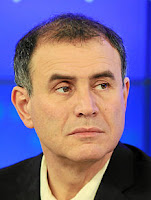 De-Risking Revisited
NEW YORK – Until the recent bout of financial-market turbulence, a variety of risky assets (including equities, government bonds, and commodities) had been rallying since last summer. But, while risk aversion and volatility were falling and asset prices were rising, economic growth remained sluggish throughout the world. Now the global economy’s chickens may be coming home to roost.
Japan, struggling against two decades of stagnation and deflation, had to resort to Abenomics to avoid a quintuple-dip recession. In the United Kingdom, the debate since last summer has focused on the prospect of a triple-dip recession. Most of the eurozone remains mired in a severe recession – now spreading from the periphery to parts of the core. Even in the United States, economic performance has remained mediocre, with growth hovering around 1.5% for the last few quarters.
And now the darlings of the world economy, emerging markets, have proved unable to reverse their own slowdowns. According to the IMF,
China’s annual GDP growth has slowed to 8%, from 10% in 2010; over the
same period, India’s growth rate slowed from 11.2% to 5.7%. Russia,
Brazil, and South Africa are growing at around 3%, and other emerging
markets are slowing as well.
This
gap between Wall Street and Main Street (rising asset prices, despite
worse-than-expected economic performance) can be explained by three
factors. First, the tail risks (low-probability, high-impact events) in
the global economy – a eurozone breakup, the US going over its fiscal
cliff, a hard economic landing for China, a war between Israel and Iran
over nuclear proliferation – are lower now than they were a year ago.
Thursday, June 27, 2013
Roubini : Gold Bugs strangely silent and quiet. They must be eating crow
Nouriel Roubini :
Gold Bugs strangely silent and quiet. They must be eating crow.
For the record, Nouriel said a month ago or so, that gold was about to fall to $1000." by 2015 - in Twitter
For the record, Nouriel said a month ago or so, that gold was about to fall to $1000." by 2015 - in Twitter
Wednesday, June 26, 2013
Gold : Many Reasons Why The Bubble Has Burst
Nouriel Roubini : "At the peak, gold bugs – a combination of paranoid investors and others with a fear-based political agenda – were happily predicting gold prices going to $2,000, $3,000, and even to $5,000 in a matter of years. There are many reasons why the bubble has burst, and why gold prices are likely to move much lower, toward $1,000 by 2015." - in Finance Townhall
Tuesday, June 25, 2013
The Gold Bubble Is Deflating
Nouriel Roubini : "The runup in gold prices in recent years – from $800 per ounce in early 2009 to above $1,900 in the autumn of 2011 – had all the features of a bubble. Now, like all asset-price surges that are divorced from the fundamentals of supply and demand, the gold bubble is deflating." - in The Guardian
Gold Prices Are Likely To Move Much Lower
"There are many reasons why the bubble has burst, and why gold prices are likely to move much lower, toward $1,000 by 2015." - in The Guardian
Be Sure Your Seat Belt Is Securely Fastened
Nouriel Roubini : “Be sure your seat belt is securely fastened, because nothing has really come to rest. We have entered the ‘New Abnormal’, a period in which...the wise investor is prepared to be surprised.” - in a recent paper with Ian Bremmer
The FED Liquidity Injections Are Not Creating Credit For The Real Economy
"The Fed’s liquidity injections are not creating credit for the real economy but rather boosting leverage and risk-taking in financial markets." - in Wealth Daily
Subscribe to:
Posts (Atom)
