
Sunday, June 30, 2013
Roubini and Bremmer on Charlie Rose: Unveiling New Abnormal
“Our point is that this situation is one that is not a stable equilibrium, is not even a stable disequilibrium. It’s an unstable disequilibrium. Take for example the eurozone. You cannot have just a monetary union without banking, political, economic, fiscal union. Either you move towards more integration or you’re going to have more fragmentation and disintegration. So the situation we face right now in the global economy, same in the eurozone, is of a unstable disequilibrium, therefore a new abnormal, that cannot be sustained.”

- Read more at: http://www.economonitor.com/nouriel/2013/06/27/roubini-and-bremmer-on-charlie-rose-unveiling-new-abnormal/#sthash.9bckxZfa.dpuf

Saturday, June 29, 2013
De-Risking Revisited
NEW YORK – Until the recent bout of financial-market turbulence, a
variety of risky assets (including equities, government bonds, and
commodities) had been rallying since last summer. But, while risk
aversion and volatility were falling and asset prices were rising,
economic growth remained sluggish
 throughout the world. Now the global
economy’s chickens may be coming home to roost.
throughout the world. Now the global
economy’s chickens may be coming home to roost.
Japan, struggling against two decades of stagnation and deflation, had to resort to Abenomics to avoid a quintuple-dip recession. In the United Kingdom, the debate since last summer has focused on the prospect of a triple-dip recession. Most of the eurozone remains mired in a severe recession – now spreading from the periphery to parts of the core. Even in the United States, economic performance has remained mediocre, with growth hovering around 1.5% for the last few quarters.
And now the darlings of the world economy, emerging markets, have proved unable to reverse their own slowdowns. According to the IMF, China’s annual GDP growth has slowed to 8%, from 10% in 2010; over the same period, India’s growth rate slowed from 11.2% to 5.7%. Russia, Brazil, and South Africa are growing at around 3%, and other emerging markets are slowing as well.

Japan, struggling against two decades of stagnation and deflation, had to resort to Abenomics to avoid a quintuple-dip recession. In the United Kingdom, the debate since last summer has focused on the prospect of a triple-dip recession. Most of the eurozone remains mired in a severe recession – now spreading from the periphery to parts of the core. Even in the United States, economic performance has remained mediocre, with growth hovering around 1.5% for the last few quarters.
And now the darlings of the world economy, emerging markets, have proved unable to reverse their own slowdowns. According to the IMF, China’s annual GDP growth has slowed to 8%, from 10% in 2010; over the same period, India’s growth rate slowed from 11.2% to 5.7%. Russia, Brazil, and South Africa are growing at around 3%, and other emerging markets are slowing as well.
This
gap between Wall Street and Main Street (rising asset prices, despite
worse-than-expected economic performance) can be explained by three
factors. First, the tail risks (low-probability, high-impact events) in
the global economy – a eurozone breakup, the US going over its fiscal
cliff, a hard economic landing for China, a war between Israel and Iran
over nuclear proliferation – are lower now than they were a year ago.
Friday, June 28, 2013
Nouriel Roubini : Will Tapering expectations be tapered ?
Nouriel Roubini :
Will tapering expectations be tapered as growth disappoints, inflation falls and rise in long rates prevents reaching escape velocity? - in twitter
Roubini: Gap between Wall Street and Main Street can be explained by three factors
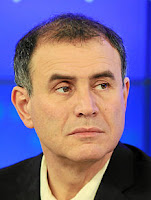 De-Risking Revisited
NEW YORK – Until the recent bout of financial-market turbulence, a variety of risky assets (including equities, government bonds, and commodities) had been rallying since last summer. But, while risk aversion and volatility were falling and asset prices were rising, economic growth remained sluggish throughout the world. Now the global economy’s chickens may be coming home to roost.
Japan, struggling against two decades of stagnation and deflation, had to resort to Abenomics to avoid a quintuple-dip recession. In the United Kingdom, the debate since last summer has focused on the prospect of a triple-dip recession. Most of the eurozone remains mired in a severe recession – now spreading from the periphery to parts of the core. Even in the United States, economic performance has remained mediocre, with growth hovering around 1.5% for the last few quarters.
And now the darlings of the world economy, emerging markets, have proved unable to reverse their own slowdowns. According to the IMF,
China’s annual GDP growth has slowed to 8%, from 10% in 2010; over the
same period, India’s growth rate slowed from 11.2% to 5.7%. Russia,
Brazil, and South Africa are growing at around 3%, and other emerging
markets are slowing as well.
This
gap between Wall Street and Main Street (rising asset prices, despite
worse-than-expected economic performance) can be explained by three
factors. First, the tail risks (low-probability, high-impact events) in
the global economy – a eurozone breakup, the US going over its fiscal
cliff, a hard economic landing for China, a war between Israel and Iran
over nuclear proliferation – are lower now than they were a year ago.
Thursday, June 27, 2013
Roubini : Gold Bugs strangely silent and quiet. They must be eating crow
Nouriel Roubini :
Gold Bugs strangely silent and quiet. They must be eating crow.
For the record, Nouriel said a month ago or so, that gold was about to fall to $1000." by 2015 - in Twitter
For the record, Nouriel said a month ago or so, that gold was about to fall to $1000." by 2015 - in Twitter
Wednesday, June 26, 2013
Gold : Many Reasons Why The Bubble Has Burst
Nouriel Roubini : "At the peak, gold bugs – a combination of paranoid investors and others with a fear-based political agenda – were happily predicting gold prices going to $2,000, $3,000, and even to $5,000 in a matter of years. There are many reasons why the bubble has burst, and why gold prices are likely to move much lower, toward $1,000 by 2015." - in Finance Townhall
Tuesday, June 25, 2013
The Gold Bubble Is Deflating
Nouriel Roubini : "The runup in gold prices in recent years – from $800 per ounce in early 2009 to above $1,900 in the autumn of 2011 – had all the features of a bubble. Now, like all asset-price surges that are divorced from the fundamentals of supply and demand, the gold bubble is deflating." - in The Guardian
Gold Prices Are Likely To Move Much Lower
"There are many reasons why the bubble has burst, and why gold prices are likely to move much lower, toward $1,000 by 2015." - in The Guardian
Be Sure Your Seat Belt Is Securely Fastened
Nouriel Roubini : “Be sure your seat belt is securely fastened, because nothing has really come to rest. We have entered the ‘New Abnormal’, a period in which...the wise investor is prepared to be surprised.” - in a recent paper with Ian Bremmer
The FED Liquidity Injections Are Not Creating Credit For The Real Economy
"The Fed’s liquidity injections are not creating credit for the real economy but rather boosting leverage and risk-taking in financial markets." - in Wealth Daily
Monday, June 24, 2013
Roubini : GOLD Bugs are a combination of paranoid Investors and others with a fear-based Political Agenda
Nouriel Roubini : “At the peak, gold bugs – a combination of paranoid investors and
others with a fear-based political agenda – were happily predicting gold
prices going to $2,000, $3,000, and even to $5,000 in a matter of
years. …
“There are many reasons why the bubble has burst, and why gold prices are likely to move much lower, toward $1,000 by 2015.”
“There are many reasons why the bubble has burst, and why gold prices are likely to move much lower, toward $1,000 by 2015.”
Sunday, June 23, 2013
Nouriel Roubini The Gold-basher (translated from German)

http://www.format.at/articles/1323/936/360376_s2/nouriel-roubini-gold-basher
The gold price will fall in the opinion of Nouriel Roubini 2015 towards $ 1000 per ounce.
An economic recovery will curb demand for the precious metal, which has increased over the past twelve years, said economics professor Roubini.
Lack of inflation and better returns on other investments such as equities were two of six reasons for a downward movement in the gold price, Roubini wrote in an article published on the website of "Project Syndicate" article. Since the beginning of the price of the precious metal has dropped by 16 percent.
After the gold price is sevenfold in the top since 2000, he is in a bear market since April. The unlimited creation of money by central banks to stimulate growth has indeed driven the stock prices in the United States to record highs, but not stoked inflation. This year, more money has been withdrawn from gold exchange-traded products than in the previous two years into it flowed.
Only gold as a hedge against "extreme risks"
"All investors should have a very small share of their portfolio in gold hold as a hedge against extreme risks of large losses," Roubini said in his article. "Other tangible assets can provide similar protection, and the risks of large losses today are certainly lower than at the height of the financial crisis."
Gold offers this year in the Standard & Poor's GSCI Index, which includes 24 commodities, the second-worst performance of silver. Since early January, the S & P GSCI has lost 3.9 percent, while the MSCI All-Country World Index of equities rose 7.7 percent. With U.S. Treasuries lost investors 1.2 percent, as an index of Bank of America shows.
The expectations for the inflation rate, measured by the breakeven rate for ten-year inflation-protected Treasuries has decreased this year by eleven percent and fell on 30 May at a ten-month low.
Saturday, June 22, 2013
Nouriel Roubini on how Oil impacts the World Economy - World National Oil Companies Congress
Nouriel Roubini on how oil impacts the world economy - World National Oil Companies Congress
We interviewed Nouriel Roubini on how oil impacts the rest of the global economy at the World National Oil Companies Congress 2013.
The annual World National Oil Companies Congress is where leaders of the world's NOCs meet each other and their partners to debate and decide the future of the oil and gas business.
Nouriel Roubini on the outlook for the world economy - World National Oil Companies Congress
Nouriel Roubini on the outlook for the world economy - World National Oil Companies Congress
We interviewed Nouriel Roubini at the World National Oil Companies Congress 2013. We asked:
- What is the outlook of the world economy and what are the implications for oil markets?
- What are the developments and lessons for the oil industry from the
financial crisis?
The annual World National Oil Companies Congress is where leaders of the world's NOCs meet each other and their partners to debate and decide the future of the oil and gas business.
We interviewed Nouriel Roubini at the World National Oil Companies Congress 2013. We asked:
- What is the outlook of the world economy and what are the implications for oil markets?
- What are the developments and lessons for the oil industry from the
financial crisis?
The annual World National Oil Companies Congress is where leaders of the world's NOCs meet each other and their partners to debate and decide the future of the oil and gas business.
Friday, June 21, 2013
Roubini warns : The Market is facing four major tail Risks
Nouriel Roubini's Presentation from SIC 2013
Altegris SIC 2013 - Roubini warns that the market is facing four major tail risks that could create major problems:
1) A breakup of the euro zone.
2) A U.S. slowdown.
3) A hard landing in China .
4) Geopolitical risks (such as Iran).
Central bank actions and the wall of liquidity chasing assets may have helped insulate the financial markets from the state of the “real economy,” Roubini says, but that situation cannot last forever.
It looks to me like Roubini basically is the source of the wall of worry that the market must climb!
Altegris SIC 2013 - Roubini warns that the market is facing four major tail risks that could create major problems:
1) A breakup of the euro zone.
2) A U.S. slowdown.
3) A hard landing in China .
4) Geopolitical risks (such as Iran).
Central bank actions and the wall of liquidity chasing assets may have helped insulate the financial markets from the state of the “real economy,” Roubini says, but that situation cannot last forever.
It looks to me like Roubini basically is the source of the wall of worry that the market must climb!
Nouriel Roubini : The UK Economy faces Important Policy Issues
Nouriel Roubini :
I am keynote speaker today at 9am the World National Oil Companies Congress in London
I am in London for business & policy meeting. Important policy issues faced by the UK economy - in Twitter
I am in London for business & policy meeting. Important policy issues faced by the UK economy - in Twitter
Thursday, June 20, 2013
Nouriel Roubini Exclusive Interview with AISM Luxemburg June 2013
Exclusive Interview between AISM and Nouriel Roubini . AISM is an independent investment advisor and wealth manager. With a recognized expertise in the selection of quality assets for its customers AISM manages and advises over 2.8 billion euros in assets, 80% in bonds and structured products, and the remainder in funds. The Research Team of AISM share many macroeconomic views with Nouriel Roubini. The American economist agreed to participate in our recent economic conference, based on the following topic: “What does the future hold for the Euro zone?” Karim Sghaier, Chairman of asset management company, hosted the exclusive interview Nouriel.
Wednesday, June 19, 2013
Roubini: The Fed Exit Strategy Will Be 'Treacherous'
"If financial markets are already frothy, consider how frothy they will
be when the Fed starts tightening — and then when the Fed finishes
tightening.""The Fed's (and other central banks') liquidity injections
are not creating credit for the real economy, but rather boosting
leverage and risk taking in financial markets," Roubini and Bremmer
explain.
"Thus the exit from the Fed's QE [quantitative easing] and zero-interest-rate policies will be treacherous," they maintain. say Nouriel Roubini, a New York University economist, and Ian Bremmer, president of Eurasia Group, a consulting firm in Institutional Investor in a new paper called "Unveil the New Abnormal"
"Thus the exit from the Fed's QE [quantitative easing] and zero-interest-rate policies will be treacherous," they maintain. say Nouriel Roubini, a New York University economist, and Ian Bremmer, president of Eurasia Group, a consulting firm in Institutional Investor in a new paper called "Unveil the New Abnormal"
Tuesday, June 18, 2013
Roubini & Ian Bremmer : we are living in a G-Zero world
Adding to the volatility, we’re living in a G-Zero world, in which no single power or working alliance of powers has both the muscle and the appetite to provide global leadership. That’s important, because the world needs leaders that are willing and able to accept the costs and risks of establishing and maintaining a coherent global order — putting out fires, writing the checks others can’t afford and imposing compromise to prevent conflict.
In a G-Zero world it takes a crisis to force cooperation among, and sometimes within, governments. In the U.S. only an obvious emergency could have persuaded so many lawmakers of both parties to support big-ticket bailouts and massive stimulus spending in 2008–’09. Only a potentially catastrophic market meltdown could have induced China and other emerging-markets heavyweights, Europe and the U.S. to agree on concrete actions to help pull financial markets back from the brink. It took the threat of systemic calamity to European banks — and fears for the future of the broader European project — to create public support for the sharp spending cuts that have inflicted pain across entire societies and elite support for a redesign of the euro zone. Only revolution could have toppled seemingly well-entrenched autocracies and brought the beginnings of long-overdue political change to the Middle East.
- Ian Bremmer & Nouriel Roubini in "Unveil the New Abnormal" :
Read Full Article @ http://www.institutionalinvestor.com/Article/3218470/Ian-Bremmer-and-Nouriel-Roubini-Unveil-the-New-Abnormal.html?ArticleId=3218470#.Ub8p0lj4C_q.twitter
In a G-Zero world it takes a crisis to force cooperation among, and sometimes within, governments. In the U.S. only an obvious emergency could have persuaded so many lawmakers of both parties to support big-ticket bailouts and massive stimulus spending in 2008–’09. Only a potentially catastrophic market meltdown could have induced China and other emerging-markets heavyweights, Europe and the U.S. to agree on concrete actions to help pull financial markets back from the brink. It took the threat of systemic calamity to European banks — and fears for the future of the broader European project — to create public support for the sharp spending cuts that have inflicted pain across entire societies and elite support for a redesign of the euro zone. Only revolution could have toppled seemingly well-entrenched autocracies and brought the beginnings of long-overdue political change to the Middle East.
- Ian Bremmer & Nouriel Roubini in "Unveil the New Abnormal" :
Read Full Article @ http://www.institutionalinvestor.com/Article/3218470/Ian-Bremmer-and-Nouriel-Roubini-Unveil-the-New-Abnormal.html?ArticleId=3218470#.Ub8p0lj4C_q.twitter
Monday, June 17, 2013
Nouriel Roubini Gold Price Prediction
Reason
No. 1: Gold prices tend to spike when there are serious economic,
financial, and geopolitical risks in the global economy. But, even
though this may be the case in a real and continuing financial meltdown
he feels that gold would still be a poor investment with margin calls
forcing sales with the result that the gold price can be extremely
volatile, up and down, even at the peak of such a crisis.
Reason No. 2: Roubini notes that gold performs best when there is a risk of high inflation, as its popularity as a store of value increases, but points out that despite the huge amount of monetary easing, inflation has remained low, and may actually be falling due to the velocity of money collapsing. Commercial banks are seen as hoarding the liquidity provided by the Central banks, while reduced purchasing power and low wage demands because of high unemployment are keeping inflationary pressures down.
Reason No. 3: The lack of earnings from gold argument -- While other forms of investment generate income, gold does not. So Roubini sees gold solely as a play on capital appreciation and that with the global economy, arguably, recovering, other assets are seen as generating higher returns. Indeed, QE-boosted US and global equities have vastly outperformed gold since the sharp rise in gold prices in early 2009.
Reason No. 4: The arguably more positive outlook about the US and the global economy implies that over time the Federal Reserve and other central banks will exit from quantitative easing and zero interest policy rates, which means that real rates will rise, rather than fall. With gold performing better in a zero or negative interest rate environment Roubini thus sees its attraction waning as interest rates start to rise.
Reason No. 5: Roubini argues that some of the Central banks of the more indebted nations may be tempted to liquidate part of their gold holdings and thus further depress the gold market. He points specifically to Cyprus where a report that it might sell a small fraction -- some €400 million ($520 million) -- of its gold reserves may have contributed to triggering a 13% fall in gold prices in April. Countries like Italy, which has massive gold reserves (above $130 billion), he says, could be similarly tempted, driving down prices further Roubini comments..
Reason No. 6: Here he blames some extreme political conservatives, particularly in the U.S. for overhyping gold in ways he considers to have been counterproductive. These 'fanatics', as he calls them, have suggested a return to some form of gold standard as being inevitable as they predict hyperinflation may ensue from the Central bank debasement of currency through Quantitative Easing. He goes on to say that given the absence of any conspiracy to expropriate citizens wealth, falling inflation, and what he sees as the inability to use gold as a currency, such arguments cannot be sustained. www.mineweb.com/mineweb/content/en/minew
Reason No. 2: Roubini notes that gold performs best when there is a risk of high inflation, as its popularity as a store of value increases, but points out that despite the huge amount of monetary easing, inflation has remained low, and may actually be falling due to the velocity of money collapsing. Commercial banks are seen as hoarding the liquidity provided by the Central banks, while reduced purchasing power and low wage demands because of high unemployment are keeping inflationary pressures down.
Reason No. 3: The lack of earnings from gold argument -- While other forms of investment generate income, gold does not. So Roubini sees gold solely as a play on capital appreciation and that with the global economy, arguably, recovering, other assets are seen as generating higher returns. Indeed, QE-boosted US and global equities have vastly outperformed gold since the sharp rise in gold prices in early 2009.
Reason No. 4: The arguably more positive outlook about the US and the global economy implies that over time the Federal Reserve and other central banks will exit from quantitative easing and zero interest policy rates, which means that real rates will rise, rather than fall. With gold performing better in a zero or negative interest rate environment Roubini thus sees its attraction waning as interest rates start to rise.
Reason No. 5: Roubini argues that some of the Central banks of the more indebted nations may be tempted to liquidate part of their gold holdings and thus further depress the gold market. He points specifically to Cyprus where a report that it might sell a small fraction -- some €400 million ($520 million) -- of its gold reserves may have contributed to triggering a 13% fall in gold prices in April. Countries like Italy, which has massive gold reserves (above $130 billion), he says, could be similarly tempted, driving down prices further Roubini comments..
Reason No. 6: Here he blames some extreme political conservatives, particularly in the U.S. for overhyping gold in ways he considers to have been counterproductive. These 'fanatics', as he calls them, have suggested a return to some form of gold standard as being inevitable as they predict hyperinflation may ensue from the Central bank debasement of currency through Quantitative Easing. He goes on to say that given the absence of any conspiracy to expropriate citizens wealth, falling inflation, and what he sees as the inability to use gold as a currency, such arguments cannot be sustained. www.mineweb.com/mineweb/content/en/minew
Sunday, June 16, 2013
Nouriel Roubini speech at the New York Forum Africa in Libreville Gabon
FRIDAY, JUNE 14 : Video of Nouriel Roubini's speech at the New York Forum Africa in Libreville Gabon
FUTURE FLASH: NOURIEL ROUBINI from Richard Attias & Associates on Vimeo.
Saturday, June 15, 2013
Gold : A Keynes’s ‘Barbarous Relic’
Nouriel Roubini : “Gold remains John Maynard Keynes’s ‘barbarous relic,’ with no intrinsic value and used mainly as a hedge against mostly irrational fear and panic.” - in Minyanville
Friday, June 14, 2013
Nouriel Roubini : France, does not look much better than the Periphery
Nouriel Roubini : The bond vigilantes may have woken up first in Greece, Ireland, and Portugal. "But France, does not look much better than the periphery." - in CNBC
Roubini : We have too much Private Debt in the case of Ireland
Nouriel Roubini : "We have too much private debt in the case of Ireland," - in CNBC
Thursday, June 13, 2013
Nouriel Roubini : Greece becomes first developed Nation to be cut to Emerging Market status by MSCI
Nouriel Roubini :
Submerged economy @BloombergNews: Greece becomes first developed nation to be cut to emerging market status by MSCI - in twitter
Wednesday, June 12, 2013
Roubini On The fall of Gold and Crude prices and Future of Equity
Nouriel Roubini : It’s not clear because the reason why commodity prices are falling is global growth scare and weaknesses in the euro zone, the UK and in Japan and now slowdown in US growth. There is also growth scare coming from the fact that China is showing signs of slowing down and other BRICS countries are also having weak economic growth. If that growth scare is more than a scare, that is going to affect the earnings and profitability. That is going to actually be a negative for the US and other global economies. - in livemint
Roubini On the proposed BRICS bank
Nouriel Roubini : Well, BRICS sort of agreed to create the bank that could provide funding for productive investment to BRICS and other emerging markets. The details of that bank are still very fuzzy: Where will it be located? Who will provide most of the capital? Talks of the BRICS bank are a signal that emerging markets are somehow tired about global and financial institutions such as International Monetary Fund and World Bank where the executive boards are still controlled by advanced economies. They want to create a financial institution on which they have greater control. That in some sense is a negative signal because until now approach to financial stability has been driving global institutions, rather than the regional ones.
BRICS are non-homogenous types of countries and economies. Some have political systems which are democratic like India, Brazil and South Africa and some of them are authoritarian like Russia and China. Again, some of them have comparative advantage in goods like China and services like India. It is not a very homogenous group and we need to see whether the BRICS bank is going to materialize and be successful. - in livemint
Nouriel Roubini : I do not expect a Recession in the US
Nouriel Roubini : I do not expect a recession in the US. The effect of the fiscal drag on growth is going to be significant. Between raising taxes and cutting spending through sequester, you have a fiscal drag which is probably close to 1.5% of gross domestic product (GDP) and I expect the US economy to grow this year below trend at 1.6% or 1.7%. I do not expect a double-dip recession. The situation is different in Japan. It has several quarters of negative growth, recession and ongoing deflation. What the government is doing right now is restoring ambition to do monetary and fiscal stimulus to stop deflation, jump start the economic growth, weaken yen and boost stock market.
The monetary and fiscal easing is necessary. But, on the other side, over time Japan will have to think about doing fiscal consolidation because debt is high and unsustainable. If Japan wants to grow faster, it will have to do structural reforms to liberalize the economy and trade. As long as Japan does all the steps such as monetary and fiscal easing, structural reforms and trade liberalization there is a chance that things will work out. Instead, it Japan does only monetary and fiscal easing and does not focus on structural reforms and trade liberation, the monetary easing effects will fizzle out. - in livemint
Tuesday, June 11, 2013
Nouriel Roubini : Gold Falls to Lowest in More Than Two Weeks on Stimulus Outlook
Nouriel Roubini :
Gold Falls to Lowest in More Than Two Weeks on Stimulus Outlook - Bloomberg http://bit.ly/116yUZQ - in Twitter
Monday, June 10, 2013
Roubini: When to Expect the Next Big Market Crash
April 22 (Bloomberg) -- New York University economics professor Nouriel Roubini talks about the outlook for the global economy and the impact of central bank policy and austerity programs on growth. Roubini spoke with Bloomberg's Sara Eisen April 19 on the sidelines of the IMF and World Bank meetings in Washington. (Source: Bloomberg)
Sunday, June 9, 2013
James Rickards on Roubini Gold $1000/oz Forecast
James Rickards, author of "Currency Wars: The Making of the Next Global Crisis" spoke w/ Kitco News' Daniela Cambone to counter Nouriel Roubini's prediction that gold will drop to $,1000 by 2015. The two have been known to debate openly on Twitter and never shy away of sharing their opinions. See what Rickards has to say about Roubini's six-prong analysis as to why he thinks gold will drop and why Rickards thinks market fundamentals may prove otherwise. Kitco News, Feb. 25, 2013
Saturday, June 8, 2013
Roubini : Gold going toward $1,000 by 2015
There are many reasons why the bubble has burst, and why gold prices are likely to move much lower, toward $1,000 by 2015.
First,
gold prices tend to spike when there are serious economic, financial,
and geopolitical risks in the global economy. During the global
financial crisis, even the safety of bank deposits and government bonds
was in doubt for some investors. If you worry about financial
Armageddon, it is indeed metaphorically the time to stock your bunker
with guns, ammunition, canned food, and gold bars. - in .project-syndicate
Friday, June 7, 2013
Roubini : I worry more about Asset Bubble risks than the traditional risk of goods Inflation
Nouriel Roubini : “I worry more about asset bubble risks than the traditional risk of goods inflation,” Roubini told swissinfo.ch. “At the moment, we are witnessing a frothiness in asset prices that could lead to a bubble – not this year, but possibly next – and eventually end up in a crash.” - at the Swiss Economic Forum in Interlaken
The Eurozone will at best experience a continuing recession for a decade to come
Roubini forecast the eurozone to “at best” experience a continuing recession for a decade to come, a situation that would harm Swiss exporters and pile more pressure on the SNB to continue its euro spending spree.
“The eurozone is no longer in the emergency room, but it is still in a chronically critical condition,” Roubini said. - at the Swiss Economic Forum in Interlaken
Roubini : The Swiss Financial System will continue to flourish
Nouriel Roubini : “Switzerland is linked to the eurozone; no country is an island. But any country with such sound institutions and economic framework will be able to withstand shocks,”“The Swiss financial system will continue to flourish because it provides a far more diverse range of financial and asset management services than other jurisdictions,” he said. “There are some jurisdictions that rely purely on tax evasion to survive.” - in Swiss Economic Forum in Interlaken
Thursday, June 6, 2013
Nouriel Roubini : Japan ~ Abenomics is not just a Monetary and Fiscal Stimulus
Nouriel Roubini : “Abenomics is not just a monetary and fiscal stimulus,” it’s also increasing nominal wages to boost consumption, among other actions, said Roubini. “There is going to be volatility,” he said, but he does not see a crash of Japan’s stock market, yen or Japanese government bonds.
“Japan for once in 20 years could be a better story than other markets,”
“Japan for once in 20 years could be a better story than other markets,”
Wednesday, June 5, 2013
Roubini : After the Gold Rush
VENICE – The run-up in gold prices in recent years – from $800 per ounce in early 2009 to above $1,900 in the fall of 2011 – had all the features of a bubble. And now, like all asset-price surges that are divorced from the fundamentals of supply and demand, the gold bubble is deflating.
At the peak, gold bugs – a combination of paranoid investors and others with a fear-based political agenda – were happily predicting gold prices going to $2,000, $3,000, and even to $5,000 in a matter of years. But prices have moved mostly downward since then. In April, gold was selling for close to $1,300 per ounce – and the price is still hovering below $1400, an almost 30% drop from the 2011 high.
There are many reasons why the bubble has burst, and why gold prices are likely to move much lower, toward $1,000 by 2015.
First, gold prices tend to spike when there are serious economic, financial, and geopolitical risks in the global economy. During the global financial crisis, even the safety of bank deposits and government bonds was in doubt for some investors. If you worry about financial Armageddon, it is indeed metaphorically the time to stock your bunker with guns, ammunition, canned food, and gold bars.
But, even in that dire scenario, gold might be a poor investment. Indeed, at the peak of the global financial crisis in 2008 and 2009, gold prices fell sharply a few times. In an extreme credit crunch, leveraged purchases of gold cause forced sales, because any price correction triggers margin calls. As a result, gold can be very volatile – upward and downward – at the peak of a crisis.
Second, gold performs best when there is a risk of high inflation, as its popularity as a store of value increases. But, despite very aggressive monetary policy by many central banks – successive rounds of “quantitative easing” have doubled, or even tripled, the money supply in most advanced economies – global inflation is actually low and falling further.
The reason is simple: while base money is soaring, the velocity of money has collapsed, with banks hoarding the liquidity in the form of excess reserves. Ongoing private and public debt deleveraging has kept global demand growth below that of supply.
Thus, firms have little pricing power, owing to excess capacity, while workers’ bargaining power is low, owing to high unemployment. Moreover, trade unions continue to weaken, while globalization has led to cheap production of labor-intensive goods in China and other emerging markets, depressing the wages and job prospects of unskilled workers in advanced economies.
With little wage inflation, high goods inflation is unlikely. If anything, inflation is now falling further globally as commodity prices adjust downward in response to weak global growth. And gold is following the fall in actual and expected inflation.
Third, unlike other assets, gold does not provide any income. Whereas equities have dividends, bonds have coupons, and homes provide rents, gold is solely a play on capital appreciation. Now that the global economy is recovering, other assets – equities or even revived real estate – thus provide higher returns. Indeed, US and global equities have vastly outperformed gold since the sharp rise in gold prices in early 2009.
Fourth, gold prices rose sharply when real (inflation-adjusted) interest rates became increasingly negative after successive rounds of quantitative easing. The time to buy gold is when the real returns on cash and bonds are negative and falling. But the more positive outlook about the US and the global economy implies that over time the Federal Reserve and other central banks will exit from quantitative easing and zero policy rates, which means that real rates will rise, rather than fall.
Fifth, some argued that highly indebted sovereigns would push investors into gold as government bonds became more risky. But the opposite is happening now. Many of these highly indebted governments have large stocks of gold, which they may decide to dump to reduce their debts. Indeed, a report that Cyprus might sell a small fraction – some €400 million ($520 million) – of its gold reserves triggered a 13% fall in gold prices in April. Countries like Italy, which has massive gold reserves (above $130 billion), could be similarly tempted, driving down prices further.
Sixth, some extreme political conservatives, especially in the United States, hyped gold in ways that ended up being counterproductive. For this far-right fringe, gold is the only hedge against the risk posed by the government’s conspiracy to expropriate private wealth. These fanatics also believe that a return to the gold standard is inevitable as hyperinflation ensues from central banks’ “debasement” of paper money. But, given the absence of any conspiracy, falling inflation, and the inability to use gold as a currency, such arguments cannot be sustained.
A currency serves three functions, providing a means of payment, a unit of account, and a store of value. Gold may be a store of value for wealth, but it is not a means of payment; you cannot pay for your groceries with it. Nor is it a unit of account; prices of goods and services, and of financial assets, are not denominated in gold terms.
So gold remains John Maynard Keynes’s “barbarous relic,” with no intrinsic value and used mainly as a hedge against mostly irrational fear and panic. Yes, all investors should have a very modest share of gold in their portfolios as a hedge against extreme tail risks. But other real assets can provide a similar hedge, and those tail risks – while not eliminated – are certainly lower today than at the peak of the global financial crisis.
While gold prices may temporarily move higher in the next few years, they will be very volatile and will trend lower over time as the global economy mends itself. The gold rush is over.
Read more at http://www.project-syndicate.org/commentary/the-end-of-the-gold-bubble-by-nouriel-roubini#hEOedyy5C6U4Jq05.99
At the peak, gold bugs – a combination of paranoid investors and others with a fear-based political agenda – were happily predicting gold prices going to $2,000, $3,000, and even to $5,000 in a matter of years. But prices have moved mostly downward since then. In April, gold was selling for close to $1,300 per ounce – and the price is still hovering below $1400, an almost 30% drop from the 2011 high.
There are many reasons why the bubble has burst, and why gold prices are likely to move much lower, toward $1,000 by 2015.
First, gold prices tend to spike when there are serious economic, financial, and geopolitical risks in the global economy. During the global financial crisis, even the safety of bank deposits and government bonds was in doubt for some investors. If you worry about financial Armageddon, it is indeed metaphorically the time to stock your bunker with guns, ammunition, canned food, and gold bars.
But, even in that dire scenario, gold might be a poor investment. Indeed, at the peak of the global financial crisis in 2008 and 2009, gold prices fell sharply a few times. In an extreme credit crunch, leveraged purchases of gold cause forced sales, because any price correction triggers margin calls. As a result, gold can be very volatile – upward and downward – at the peak of a crisis.
Second, gold performs best when there is a risk of high inflation, as its popularity as a store of value increases. But, despite very aggressive monetary policy by many central banks – successive rounds of “quantitative easing” have doubled, or even tripled, the money supply in most advanced economies – global inflation is actually low and falling further.
The reason is simple: while base money is soaring, the velocity of money has collapsed, with banks hoarding the liquidity in the form of excess reserves. Ongoing private and public debt deleveraging has kept global demand growth below that of supply.
Thus, firms have little pricing power, owing to excess capacity, while workers’ bargaining power is low, owing to high unemployment. Moreover, trade unions continue to weaken, while globalization has led to cheap production of labor-intensive goods in China and other emerging markets, depressing the wages and job prospects of unskilled workers in advanced economies.
With little wage inflation, high goods inflation is unlikely. If anything, inflation is now falling further globally as commodity prices adjust downward in response to weak global growth. And gold is following the fall in actual and expected inflation.
Third, unlike other assets, gold does not provide any income. Whereas equities have dividends, bonds have coupons, and homes provide rents, gold is solely a play on capital appreciation. Now that the global economy is recovering, other assets – equities or even revived real estate – thus provide higher returns. Indeed, US and global equities have vastly outperformed gold since the sharp rise in gold prices in early 2009.
Fourth, gold prices rose sharply when real (inflation-adjusted) interest rates became increasingly negative after successive rounds of quantitative easing. The time to buy gold is when the real returns on cash and bonds are negative and falling. But the more positive outlook about the US and the global economy implies that over time the Federal Reserve and other central banks will exit from quantitative easing and zero policy rates, which means that real rates will rise, rather than fall.
Fifth, some argued that highly indebted sovereigns would push investors into gold as government bonds became more risky. But the opposite is happening now. Many of these highly indebted governments have large stocks of gold, which they may decide to dump to reduce their debts. Indeed, a report that Cyprus might sell a small fraction – some €400 million ($520 million) – of its gold reserves triggered a 13% fall in gold prices in April. Countries like Italy, which has massive gold reserves (above $130 billion), could be similarly tempted, driving down prices further.
Sixth, some extreme political conservatives, especially in the United States, hyped gold in ways that ended up being counterproductive. For this far-right fringe, gold is the only hedge against the risk posed by the government’s conspiracy to expropriate private wealth. These fanatics also believe that a return to the gold standard is inevitable as hyperinflation ensues from central banks’ “debasement” of paper money. But, given the absence of any conspiracy, falling inflation, and the inability to use gold as a currency, such arguments cannot be sustained.
A currency serves three functions, providing a means of payment, a unit of account, and a store of value. Gold may be a store of value for wealth, but it is not a means of payment; you cannot pay for your groceries with it. Nor is it a unit of account; prices of goods and services, and of financial assets, are not denominated in gold terms.
So gold remains John Maynard Keynes’s “barbarous relic,” with no intrinsic value and used mainly as a hedge against mostly irrational fear and panic. Yes, all investors should have a very modest share of gold in their portfolios as a hedge against extreme tail risks. But other real assets can provide a similar hedge, and those tail risks – while not eliminated – are certainly lower today than at the peak of the global financial crisis.
While gold prices may temporarily move higher in the next few years, they will be very volatile and will trend lower over time as the global economy mends itself. The gold rush is over.
Read more at http://www.project-syndicate.org/commentary/the-end-of-the-gold-bubble-by-nouriel-roubini#hEOedyy5C6U4Jq05.99
Tuesday, June 4, 2013
Roubini Sees Two Years of Stock Gains
"Growth is not going to pick up and inflation actually is falling," the head of Roubini Global Economics and noted "Dr. Doom" told "Closing Bell." "So the markets are worried about tapering off sooner, but I think tapering off is going to occur later and therefore the market is going to rally." "You're going to have an increasing gap between Wall Street and Main Street, between what's happening to asset prices and real economic growth," he said. The effect of the Fed helping stock prices "for now is dominant, but of course over time it cannot trump those gravitational forces of economic fundamentals."
Six reasons why the gold rush is over - Nouriel Roubini

As a Devil’s Advocate writing a contrary opinion to those who are convinced that the gold price will soon resume its upwards trajectory, Economist Nouriel Roubini has few equals. Indeed to the ardent gold believer Roubini may well be considered the Devil himself, rather than just an Advocate for the Satanic master.
In his latest opinion on gold, Roubini pulls few punches, although he does condescend at the end that the gold price will be volatile and could still temporarily move higher in the next few years. But he qualifies this in saying that the overall trend will be lower over time as the global economy mends itself. “The gold rush is over”, he says and predicts gold falling towards $1,000 by 2015. The run up in gold from $800 in early 2009 to over $1900 in 2012 “had all the features of a bubble” he says. “And now, like all asset-price surges that are divorced from the fundamentals of supply and demand, the gold bubble is deflating.”
While any number of the bullish commentators on gold take delight in publishing a number of reasons why gold will move upwards, Roubini does the opposite with his six reasons why gold will continue to fall back.
Reason No. 1: Gold prices tend to spike when there are serious economic, financial, and geopolitical risks in the global economy. But, even though this may be the case in a real and continuing financial meltdown he feels that gold would still be a poor investment with margin calls forcing sales with the result that the gold price can be extremely volatile, up and down, even at the peak of such a crisis.
Reason No. 2: Roubini notes that gold performs best when there is a risk of high inflation, as its popularity as a store of value increases, but points out that despite the huge amount of monetary easing, inflation has remained low, and may actually be falling due to the velocity of money collapsing. Commercial banks are seen as hoarding the liquidity provided by the Central banks, while reduced purchasing power and low wage demands because of high unemployment are keeping inflationary pressures down.
http://www.mineweb.com/mineweb/content/en/mineweb-gold-news?oid=192868&sn=Detail
Gold prices are heading towards $1,000
The runup in gold prices in recent years – from $800 per ounce in early 2009 to above $1,900 in the autumn of 2011 – had all the features of a bubble. Now, like all asset-price surges that are divorced from the fundamentals of supply and demand, the gold bubble is deflating.

At the peak, gold bugs – a combination of paranoid investors and others with a fear-based political agenda – were happily predicting gold prices going to $2,000, $3,000 and even to $5,000 in a matter of years. But prices have moved mostly downward since then. In April, gold was selling for close to $1,300 per ounce and the price is still hovering below $1,400, an almost 30% drop from the 2011 high.
There are many reasons why the bubble has burst, and why gold prices are likely to move much lower, toward $1,000 by 2015.
First, gold prices tend to spike when there are serious economic, financial and geopolitical risks in the global economy. During the global financial crisis, even the safety of bank deposits and government bonds was in doubt for some investors. If you worry about financial Armageddon, it is indeed metaphorically the time to stock your bunker with guns, ammunition, canned food and gold bars.
http://www.guardian.co.uk/business/economics-blog/2013/jun/03/gold-bubble-bursts-nouriel-roubini
At the peak, gold bugs – a combination of paranoid investors and others with a fear-based political agenda – were happily predicting gold prices going to $2,000, $3,000 and even to $5,000 in a matter of years. But prices have moved mostly downward since then. In April, gold was selling for close to $1,300 per ounce and the price is still hovering below $1,400, an almost 30% drop from the 2011 high.
There are many reasons why the bubble has burst, and why gold prices are likely to move much lower, toward $1,000 by 2015.
First, gold prices tend to spike when there are serious economic, financial and geopolitical risks in the global economy. During the global financial crisis, even the safety of bank deposits and government bonds was in doubt for some investors. If you worry about financial Armageddon, it is indeed metaphorically the time to stock your bunker with guns, ammunition, canned food and gold bars.
http://www.guardian.co.uk/business/economics-blog/2013/jun/03/gold-bubble-bursts-nouriel-roubini
Monday, June 3, 2013
Nouriel Roubini on why Gold prices are headed much lower
VENICE – The run-up in gold prices in recent years – from $800 per ounce
in early 2009 to above $1,900 in the fall of 2011 – had all the
features of a bubble. And now, like all asset-price surges that are
divorced from the fundamentals of supply and demand, the gold bubble is
deflating.
At the peak, gold bugs – a
combination of paranoid investors and others with a fear-based political
agenda – were happily predicting gold prices going to $2,000, $3,000,
and even to $5,000 in a matter of years. But prices have moved mostly
downward since then. In April, gold was selling for close to $1,300 per
ounce – and the price is still hovering below $1400, an almost 30% drop
from the 2011 high.
There are many reasons why the bubble has burst, and why gold prices are likely to move much lower, toward $1,000 by 2015.
First,
gold prices tend to spike when there are serious economic, financial,
and geopolitical risks in the global economy. During the global
financial crisis, even the safety of bank deposits and government bonds
was in doubt for some investors. If you worry about financial
Armageddon, it is indeed metaphorically the time to stock your bunker
with guns, ammunition, canned food, and gold bars.
But,
even in that dire scenario, gold might be a poor investment. Indeed, at
the peak of the global financial crisis in 2008 and 2009, gold prices
fell sharply a few times. In an extreme credit crunch, leveraged
purchases of gold cause forced sales, because any price correction
triggers margin calls. As a result, gold can be very volatile – upward
and downward – at the peak of a crisis.
Second,
gold performs best when there is a risk of high inflation, as its
popularity as a store of value increases. But, despite very aggressive
monetary policy by many central banks – successive rounds of
“quantitative easing” have doubled, or even tripled, the money supply in
most advanced economies – global inflation is actually low and falling
further.
Sunday, June 2, 2013
Nouriel Roubini : Art is a new major Asset Class
Nouriel Roubini :
From the Venice Art Biennal it looks like art is indeed a new major asset class. It may be in a bubble as a frenzy of new collectors emerges - in twitter
Saturday, June 1, 2013
Nouriel Roubini | After the Gold Rush
Venice: The run-up in gold prices in recent
years—from $800 per ounce in early 2009 to above $1,900 in the fall of
2011—had all the features of a bubble. And now, like all asset-price
surges that are divorced from the fundamentals of supply and demand, the
gold bubble is deflating.
At the peak, gold bugs—a combination of paranoid
investors and others with a fear-based political agenda—were happily
predicting gold prices going to $2,000, $3,000, and even to $5,000 in a
matter of years. But prices have moved mostly downward since then. In
April, gold was selling for close to $1,300 per ounce—and the price is
still hovering below $1400, an almost 30% drop from the 2011 high.
There are many reasons why the bubble has burst, and why gold prices are likely to move much lower, toward $1,000 by 2015.
First, gold prices tend to spike when there are serious
economic, financial, and geopolitical risks in the global economy.
During the global financial crisis, even the safety of bank deposits and
government bonds was in doubt for some investors. If you worry about
financial Armageddon, it is indeed metaphorically the time to stock your
bunker with guns, ammunition, canned food, and gold bars.
But, even in that dire scenario, gold might be a poor
investment. Indeed, at the peak of the global financial crisis in 2008
and 2009, gold prices fell sharply a few times. In an extreme credit
crunch, leveraged purchases of gold cause forced sales, because any
price correction triggers margin calls. As a result, gold can be very
volatile—upward and downward—at the peak of a crisis.
Friday, May 31, 2013
Nouriel Roubini : The Fed is creating massive Fraud
Nouriel Roubini : "They [The Fed] are creating massive fraud," Roubini said during a panel at the
Milken Institute Global Conference in Beverly Hills, Calif., last week.
He pointed to the junk bond market as one example of a bubble.
"At some point, there's a levitational problem," said Roubini. When gravity sets in, Roubini says there will not be a recession but a depression.
"The global growth scare would imply that commodity prices should be lower, bond yields should be lower, and equities should be lower," he said.
He pointed to the junk bond market as one example of a bubble.
"At some point, there's a levitational problem," said Roubini. When gravity sets in, Roubini says there will not be a recession but a depression.
"The global growth scare would imply that commodity prices should be lower, bond yields should be lower, and equities should be lower," he said.
Thursday, May 30, 2013
Roubini On Quantitative Easing & Asset Bubbles
It is hard to predict bubbles and their bursts, but I would say that we are having tension in the US and the global economy. On one side, growth is weak in advanced economies and unemployment rate is high and that justifies more quantitative easing. Existing quantitative easing and zero policy rate very slowly will try and support recovery but on the other side, a lot of this liquidity is not creating credit for the real economy and is going into asset prices, greater risk taking and greater leveraging into the financial system.
There is already frothiness in the asset market in the US and over time low rates are going to cause credit, asset and equity bubbles which may become dangerous. Not today, but certainly three to four years of zero policy rates will lead to that. There could be a repeat of the cycle which we had seen between 2004 and 2008 when real economy weakness justified keeping rates low for longer and exiting from those low rates slower, but that attempt to stabilize the real economy created financial instability and frothiness that led to a bubble which eventually busted. - in livemint
There is already frothiness in the asset market in the US and over time low rates are going to cause credit, asset and equity bubbles which may become dangerous. Not today, but certainly three to four years of zero policy rates will lead to that. There could be a repeat of the cycle which we had seen between 2004 and 2008 when real economy weakness justified keeping rates low for longer and exiting from those low rates slower, but that attempt to stabilize the real economy created financial instability and frothiness that led to a bubble which eventually busted. - in livemint
Wednesday, May 29, 2013
Italy Trip Report: A Fragile Economic and Political Environment
Nouriel Roubini :
My new paper with RGE's Brunello Rosa - Italy Trip Report: A Fragile Economic and Political Environment http://bit.ly/10zvTAR $$ - in twitter
Subscribe to:
Posts (Atom)
